Begin with the workflow, not the product link
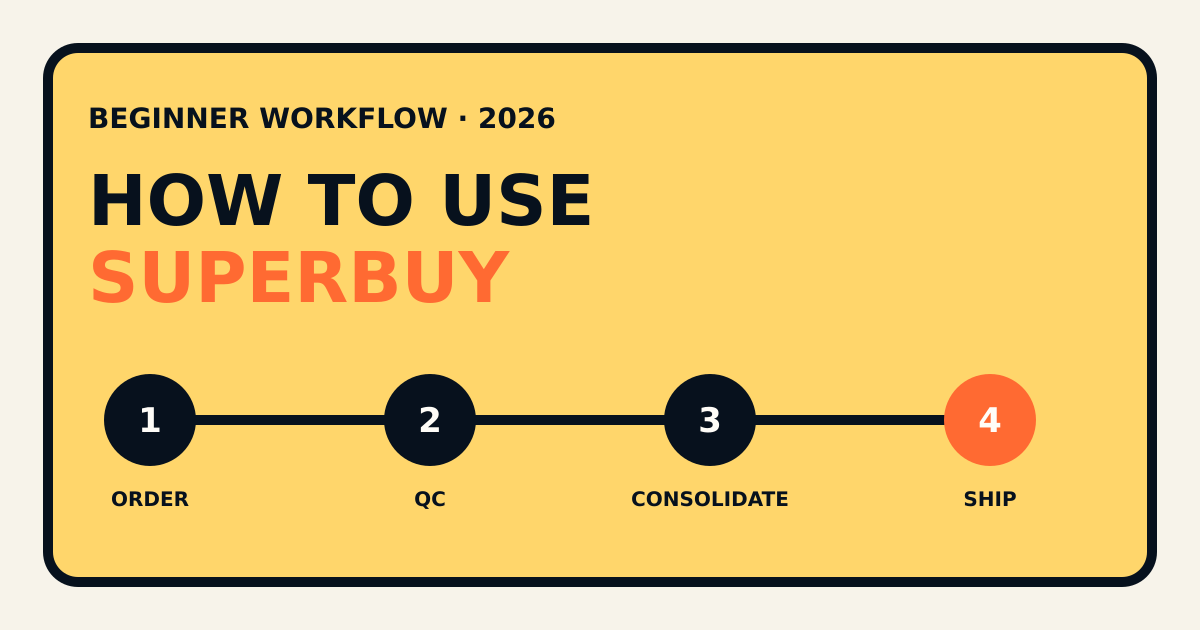
Learning how to use Superbuy starts with understanding that the service sits between you and third-party Chinese sellers. You are not normally buying warehouse-owned stock. You identify a product, Superbuy places or supports the domestic purchase, the seller sends it to the warehouse, and you decide what happens after visible inspection. Accepted items can then be combined into an international parcel.
The process has two financial stages. First you fund the product and Chinese domestic delivery. Later you pay for international shipping after the warehouse has the goods and a parcel plan exists. This means a low marketplace price is only an entry cost. Before ordering, you need enough information to estimate the item, warehouse and international stages together.
Step 1: verify the listing before submitting it
Open the current seller page rather than relying on an old spreadsheet thumbnail. Confirm the seller, selected color, size, model, quantity, material claim, current price and Chinese domestic freight. Some listings display the cheapest accessory, deposit or incomplete option first. Re-select the exact variation you want and record the result with a date.
Write order remarks only for requirements the seller can reasonably understand and fulfill. A useful remark names the chosen variation or asks for a specific included component. A vague instruction such as “make sure it is perfect” creates no measurable standard. If the product page is inconsistent, ask a question before payment or choose another listing.
Decide the rejection conditions at this stage. Examples include the wrong model, a measurement outside an acceptable range, visible structural damage, a missing accessory or a plug type that cannot be used at the destination. These conditions will later turn warehouse photographs into a decision rather than a casual visual check.
Step 2: submit the order accurately
Paste the original marketplace link into the buying interface and select the matching options. Check that quantity, color, size and displayed price match your notes. If the system cannot automatically read the listing, manual details become more important. Use the seller's own option language where possible and keep a screenshot of the selection that was funded.
After payment, monitor whether the agent accepts the order, whether the seller dispatches and whether a price or availability exception appears. Do not approve a substitute merely because its product title looks similar. Compare the new URL, specification, variation and full stage-one cost against the original requirement. If the replacement no longer achieves the intended result, cancellation before purchase may be the cheaper decision.
| Status | What to confirm | Next action |
|---|---|---|
| Pending purchase | Variation, quantity, remarks and funded price | Correct errors before the agent buys |
| Seller dispatched | Domestic tracking and expected package count | Watch for split shipments or delays |
| Warehouse received | Order identity, quantity and visible condition | Begin the QC decision immediately |
| Exception | Price, stock, variation or seller change | Approve, clarify or cancel with evidence |
Step 3: review warehouse QC while action is possible
When the item arrives, compare the warehouse record with your order evidence. Start with identity: model, color, size and quantity. Then inspect the overall shape, symmetry, edges, seams, hardware, prints, labels and included parts that are visible. Large mismatches matter before minor cosmetic questions.
Photographs have limits. Lighting can shift color, camera angle can distort proportions and standard views may not show a decisive measurement. They cannot prove hidden materials, internal electronics, authenticity or future durability. If an unanswered visible fact could change your decision, request one focused image or measurement. “Measure the removable insole heel to toe with both ruler endpoints visible” is more useful than “check the shoes carefully.”
Record one of three outcomes: approve, clarify or seek a seller remedy. Do this promptly because warehouse storage and seller return timing are different. Superbuy currently describes up to 90 days of free storage for eligible goods, but that does not automatically extend a seller's exchange or return window.
Step 4: decide which items belong together
Once items are accepted, assign them to a proposed parcel. Consolidation can reduce repeated base charges, but one large, fragile or restricted item can remove useful routes or increase volumetric weight. Compare at least two structures: one combined parcel and a split based on size, fragility or restrictions.
Actual weight is measured on a scale; volumetric weight represents occupied space. A light boxed item may cost more than expected when the route bills by parcel dimensions. Removing retail packaging can reduce volume, while reinforcement can increase it. Treat packaging as a trade-off between protection, evidence and chargeable size rather than an automatic choice.
Check item classifications honestly. Batteries, liquids, cosmetics, food, magnets, oversized products and some branded goods may have fewer eligible routes. Never alter or omit the description to make an unavailable line appear usable. Route selection must follow the actual goods, destination and current warehouse information.
Step 5: compare live shipping choices
Use the warehouse-recorded weights and current parcel dimensions wherever possible. Compare eligible routes on price, estimated delivery window, tracking, compensation terms, size limits and product restrictions. The cheapest line is not automatically the best value if it provides weak tracking, unsuitable protection or a poor match for the parcel.
International shipping is normally collected as a separate payment. The amount can be based on estimated parcel information and later reconciled against verified weight and dimensions. Keep the quoted amount, final amount and any refund or balance as separate records. Overwriting the estimate removes information that could improve your next shipment plan.
Step 6: preserve the delivery evidence
Save the final route, tracking number, submitted declaration, packaging request, parcel weight, dimensions and payment record. When the parcel arrives, photograph visible external damage before opening. For valuable or fragile goods, record the opening process and compare the delivered contents with the warehouse evidence.
Do not discard labels and packaging until quantity, condition and operation are confirmed. If something is wrong, a dated trail from original listing to order selection, warehouse approval, parcel submission and delivery is more useful than a general complaint. Close the order only after the delivered cost and outcome are recorded.
A simple first-order control sheet
Create one row per product with these fields: original URL, seller, chosen variation, product price, domestic freight, order status, warehouse arrival date, recorded weight, QC decision, return deadline, planned parcel and final delivered cost. Add links to saved screenshots or evidence outside the public sheet if privacy matters.
Use action-based statuses such as “QC review required,” “measurement requested,” “return decision due” and “approved for parcel A.” Broad labels such as “warehouse” hide the next step. A good control sheet should tell you what must happen today without opening every order page.
Common beginner mistakes
- Treating the marketplace price as the delivered price.
- Ordering from a screenshot without reopening the live seller page.
- Using vague remarks that cannot be inspected later.
- Waiting to review QC because the free-storage period appears long.
- Assuming standard photos prove authenticity or internal quality.
- Consolidating everything without comparing a split parcel.
- Selecting a route from someone else's old screenshot.
- Discarding evidence before delivery is fully checked.
How to handle seller messages and order exceptions
An order may stop following the expected path when a seller reports that a variation is unavailable, asks for more money, proposes a substitute or fails to dispatch. Treat each message as a new decision, not as an automatic part of the purchase. Preserve the original listing and order specification, then write down exactly what changed: variation, price, domestic freight, dispatch estimate or return condition.
Use the order enquiry channel to give one clear instruction with a fallback. For example, ask the agent to confirm whether the original color and size remain available at the approved price; if not, request that no replacement be purchased without approval. This is easier to execute than a long message containing several uncertain alternatives. Never approve a substitute from a thumbnail alone. Open the replacement listing, verify its exact variation and compare its full cost and dimensions with the original choice.
When warehouse evidence shows a mismatch, state the observable fact and desired remedy. “Received blue, ordered black” or “measured width is 46 cm; accepted range was 50–52 cm” gives the agent a usable case. Include the relevant image and act before the applicable seller or platform deadline. The warehouse storage period does not extend that deadline.
Keep the exception open until the operational result appears in the account: a corrected item reaches storage, a return is completed, or the refund is visible. A seller or agent message promising action is not the final result. Recording the outcome prevents an unresolved item from being included accidentally when you later submit the international parcel.
When is an item ready to ship?
An item is ready only when its identity is confirmed, visible QC questions are resolved, the seller-remedy decision is closed, its restriction status is understood and it has a planned parcel. A warehouse arrival notification alone is not approval. A product with unresolved measurements or battery classification should remain outside the parcel until the question is answered.
Practical rule: every stage should end with evidence and a next action. Verify before payment, decide while remedies remain possible, and build the international parcel from accepted items rather than from everything that happens to be stored.